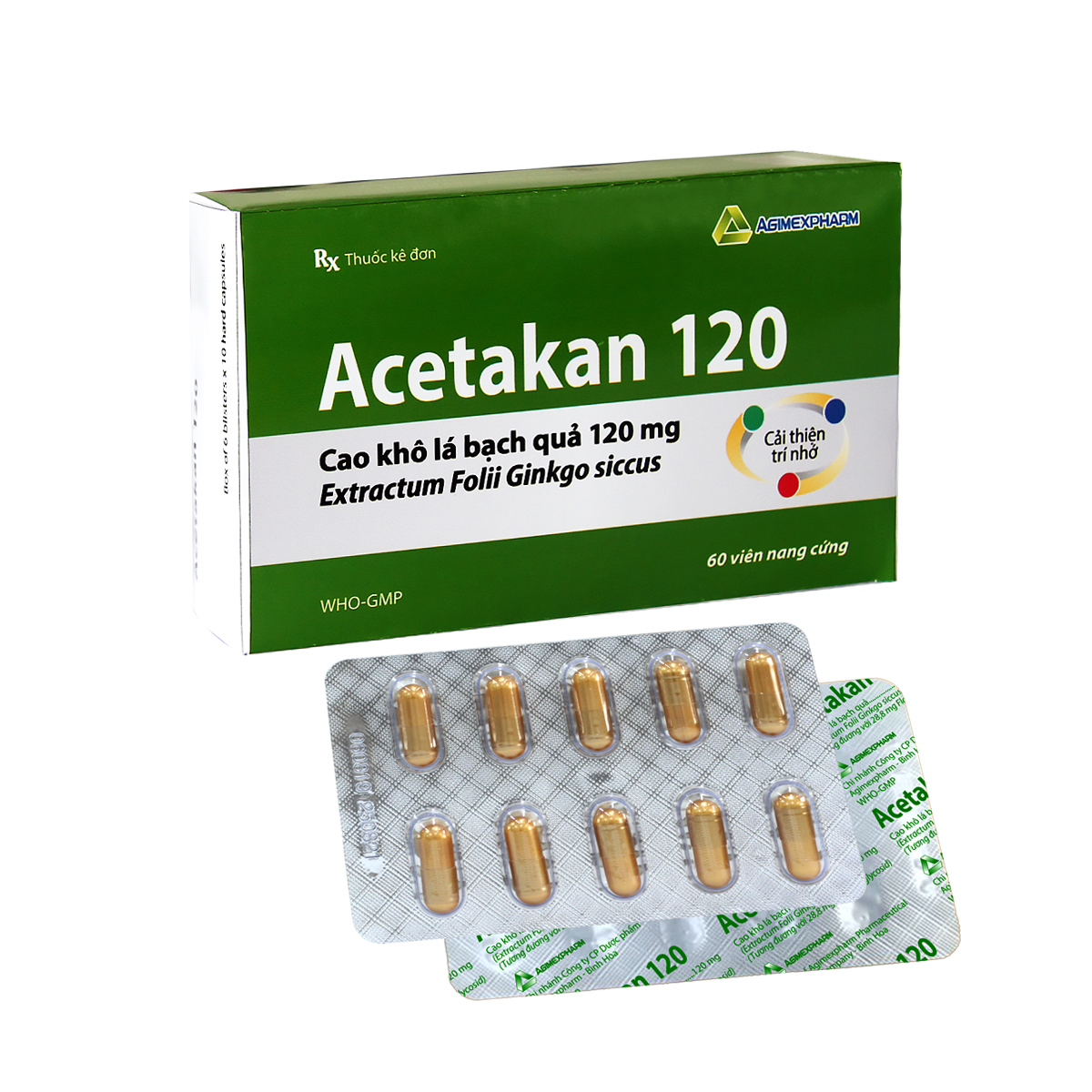
Indications:
Symptomatic treatment of mild and moderate cerebral insufficiency (syndrome of dementia in primary degenerative dementia, vascular dementia, and mixed forms of dementia), with symptoms such as: Memory impairment, impaired concentration, emotional lability, dizziness, tinnitus and headache.
Treatment of peripheral arterial obstructive disease in improvement of pain-free walking distances such as intermittent claudication, Raynaud’s disease, acrocyanosis, postphlebitic syndrome.
Treatment of inner ear disease such as tinnitus and vertigo due to vascular or degenerative problems.
Administration, dosage:
Administration:
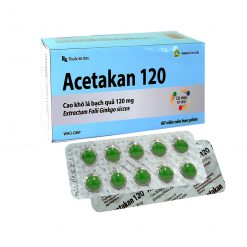
ACETAKAN 120 hard capsule should be taken during or after meals.
Dosage:
1 capsule x 1 – 2 times per day.
Some special attention on the handling of the medicine before and after use:
There are no special requirements for handling this medicine after use.
Contraindications:
Hypersensitivity to any component of this medication.
People who are bleeding or have coagulation disorders.
Children under 12 years of age.
Pregnant women or breastfeeding mothers.
Warnings and precautions for use:
Patients with reduced kidney or liver function and glucose-6-phosphate dehydrogenase deficiency.
Patients with coagulation disorders or using anticoagulation medicines.
Pregnancy and lactation:
Do not use this medicine in pregnant women or breastfeeding mothers because there are no adequate information about the safety of Ginkgo biloba for these subjects.
Effects on ability to drive and use machines:
The influence of ACETAKAN 120 hard capsule on the ability to drive and use machines has not been studied.
Interactions, incompatibilities of medicine:
Interaction with other medicinal products and other forms of interaction:
Extractum folii ginkgo siccus interacts with the human CYP450 system and its isoenzymes, which may affect the metabolism of various drugs. It may also increase the risk of bleeding in individuals taking aspirin, ibuprofen, or warfarin and increase the risk of sedation in patients taking trazodone.
Coadministration of nifedipine and extractum folii ginkgo siccus may increase plasma concentrations of nifedipine resulting in increased therapeutic and side effects.
Conversely, extractum folii ginkgo siccus may reduce plasma concentrations of omeprazole and tolbutamide, decreases therapeutic effects.
Ginkgo biloba administration may increase the efficacy and decrease extrapyramidal adverse reactions of haloperidol, but only slightly decreases the area under the curve (AUC) of alprazolam.
Incompatibilities:
Because there are no studies of drug incompatibility, do not mix this drug with other drugs.
Undesirable effects:
After long-term use mild and rare side effects were reported: Gastrointestinal disorders, headache, skin allergy.
Bleeding time may be prolonged.
Overdose and management:
There have been no information on overdose. In case of overdose, transfer patient to hospital seek medical care in time. There are no specific antidotes. Symptomatic treatment is primarily recommended.
Pharmacodynamics:
Pharmacotherapeutic group: Nervous system – Psychoanaleptics – Anti-dementia drugs.
ATC code: N06DX02
ACETAKAN 120 hard capsule contains extractum folii ginkgo siccus (Ginkgo biloba) which have the flavonoid glycosides and triterpene lactones (including ginkgolides A, B, C and bilobalide) standardized. The medicine has regulatory effects on the entire vascular system of veins, arteries, and capillaries.
Extractum folii ginkgo siccus fights against spasms of artery, dilates arterioles and on the other hand, it constricts veins, regulates varicose veins in response to postural changes, reduces excessive capillary permeability and enhances capillary endurance.
Extractum folii ginkgo siccus fights against cerebral and peripheral angioedema, protects blood-brain and retina-blood barrier. Therefore, it enhances brain-blood circulation, improves the supply of blood and oxygen to brain; increases the stability of vessel walls to result in reducing hemorrhage and edema.
Extractum folii ginkgo siccus inhibits platelet activating factor, hinders platelet agglomeration for prevention of thrombosis and cerebral vascular accident. Extractum folii ginkgo siccus has potentially antioxidant effects, neutralizes the toxic action of free radicals in cells which often occur after poor flow of blood to brain and heart muscle.
The terpene lactones, ginkgolides and bilobalide, are believed to be responsible for ability to increase blood circulation to the brain and other parts of the body.
Extractum folii ginkgo siccus improves peripheral circulation, especially lower limbs, and function of blood supply to inner ear and vestibule. It may also help relieve tinnitus and sudden deafness.
Pharmacokinetics:
Oral bioavailability of ginkgolides A, B and bilobalide is about 80 – 90%. Peak concentration is attained within 1 to 2 hours. Elimination half – life is approximately 4 hours (bilobalide, ginkgolide A) to 10 hours (ginkgolide B). These substances are not metabolized in the body and excreted predominantly in the urine, a small portion in feces.
Storage conditions, shelf life of the medicine:
Storage conditions: Protect from humidity and light, below 300C.
Shelf life: 36 months from the manufacture date.