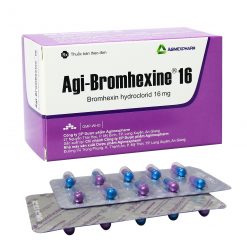
Indications, dosage, administration, contraindications:
Indications:
For the treatment of bronchial secretion disorders, particularly in acute bronchitis, acute exacerbations of chronic bronchitis.
Administration:
The tablet should be swallowed whole with a glass of water.
Dosage:
Adults and children from 12 years old and older: 1-2 tablets (8-16 mg once); 3 times a day.
Children from 6 to 11 years old (only under doctor’s instructions): 1 tablet once; 3 times a day.
A course of treatment should not last more than 5 days, unless there is a physician’s instruction.
You should consult your physician if the condition does not improve after 5 days.
Contraindications:
Patients known to be hypersensitive to bromhexine or to other ingredients of this medicine.
Special warnings and precautions for use:
Bromhexine should be avoided in combination with antitussives, drugs that reduce bronchial secretions because they may cause a risk of stagnant phlegm in the respiratory tract.
Due to its mucolytic activity, bromhexine may disrupt the gastric mucosal barrier; therefore, bromhexine should be used with caution in patients with a history of peptic ulceration.
Bromhexine should be used with caution in patients with a history of asthma since bromhexine may induce bronchial spasm in some hypersensitive people.
Clearance of bromhexine or its metabolites may be reduced in patients with severe hepatic or renal impairment; therefore, these patients should be closely monitored.
Bromhexine should be used with caution in the elderly or debilitated, or asthenic patients; children, especially children under 2 years old due to inability to expectorate resulting in excessive build-up of mucus.
Severe skin reactions such as erythema multiforme, Stevens-Johnson syndrome (SJS)/ Lyell’s syndrome, and acute generalised exanthematous pustulosis (AGEP) associated with bromhexine use have been reported. If signs and symptoms of progressive skin rash occur (sometimes associated with blisters or mucosal lesions), bromhexine should be discontinued immediately. Consulting a doctor is recommended.
Other:
This drug contains lactose. Patients with rare hereditary problems of galactose intolerance, the Lapp lactase deficiency or glucose-galactose malabsorption should not take this medicine.
The recommendation during pregnancy and lactation:
Pregnancy:
The teratogenic effects of bromhexine have not been studied in animal experiments. There are not sufficient data studied during human pregnancy, therefore, bromhexine is not recommended for pregnant women.
Lactation:
It is not known whether bromhexine is excreted in human milk; therefore, bromhexine is not recommended for breast-feeding women.
Effects on ability to drive and use machines:
No studies on the effects on ability to drive and use machines have been performed.
Interaction with other medicinal products and other forms of interactions:
Bromhexine should not be used in combination with mucolytics (including drugs that reduce bronchial secretions) such as atropine-like drugs (or anticholinergics) due to reduction of the bromhexine effect.
Bromhexine should not be used in combination with antitussives.
Combination with antibiotics (amoxicillin, cefuroxime, erythromycin, doxycycline) increases the concentration of antibiotics in pulmonary tissues and bronchi.
Tell your doctor about all the medicines you are using during the treatment with bromhexine.
Adverse drug reactions (ADR):
Uncommon, 1/1000 < ADR < 1/100
Gastrointestinal: Stomach pain, nausea, vomiting, diarrhea.
Nervous system: Headache, dizziness, sweating.
Skin: Rash, urticaria.
Respiratory: Risk of stasis of bronchial secretions in patients who are inability to get rid of sputum.
Rare, ADR <1/1000
Gastrointestinal: Dry mouth.
Liver: Increased transaminase AST, ALT.
Inform your doctor about any adverse effects you may experience when using the medicine.
Overdose and management:
Bromhexine overdose data have not been reported until now.
If overdose occurs, symptomatic and supportive treatment should be applied.