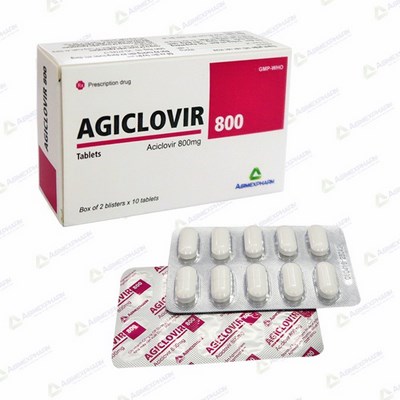
Indications:
Treatment of Varicella zoster virus infection (chickenpox) and Herpes zoster virus (shingles) (excluding neonatal HSV and severe HSV infections in immunocompromised children).
AGICLOVIR 800 tablet is recommended for use only in children over 6 years of age.
Administration, dosage
Administration: AGICLOVIR 800 tablet should be used after meals with plenty of water.
Dosage:
Treatment with aciclovir should be started as early as possible when there are signs and symptoms of disease.
Adults:
Treatment of Varicella zoster virus infection (chickenpox) and Herpes zoster virus (shingles): 800 mg once, 5 times daily (at four-hour intervals) for 7 consecutive days.
Children over 6 years of age:
Varicella zoster virus infection (chickenpox): 800 mg once, 4 times daily for 5 consecutive days.
Special subjects:
Elderly patients: The possibility of renal impairment in the elderly must be considered and the dosage should be adjusted accordingly (see Dosage in renal impairment below).
Elderly patients taking high doses of aciclovir should drink enough water.
Patients with renal impairment: Caution should be taken when administering aciclovir to patients with impaired renal function. Patients must drink enough water.
In the treatment of Herpes zoster infections, it is recommended to adjust the dosage as follows:
Creatinine clearance 10 – 25 mL/minute: 800 mg once, 3 times daily at 8 hourly intervals.
Creatinine clearance < 10 mL/minute: 800 mg once, 2 times daily at 12 hourly intervals.
Some special attention on the handling of the medicine before and after use:
There are no special requirements for handling this medicine after use.
Contraindications:
Hypersensitivity to aciclovir, or any of the excipients.
Warnings and precautions for use:
Conditions where caution should be taken:
Adequate hydration should be maintained, especially in patients receiving high doses of aciclovir. Caution should be taken when administering aciclovir to following subjects:
Patients with renal impairment and elderly patients: Aciclovir is eliminated by renal clearance, therefore the dose must be reduced in patients with renal impairment (see Dosage). Elderly patients are likely to have reduced renal function and therefore dose reduction must be considered in this group. Both elderly patients and patients with renal impairment are at increased risk of developing neurological side effects and should be closely monitored for evidence of these effects. In the reported cases, these reactions were generally reversible on discontinuation of treatment.
The risk of renal impairment is increased if aciclovir is coadministered with other nephrotoxic drugs.
Patients with severe immunodeficiency: Prolonged or repeated courses of aciclovir in severely immune-compromised individuals may result in the selection of virus strains with reduced sensitivity, which may not respond to continued aciclovir treatment.
Patients with underlying neurological abnormalities, severe liver failure: Electrolyte abnormalities or signs of significant hypoxemia.
This medicine contains lactose: Patients with rare hereditary problems of galactose intolerance, the Lapp lactase deficiency or glucose-galactose malabsorption should not take this medicine.
Pregnancy and lactation:
Pregnancy: Aciclovir should be used during pregnancy only if the potential benefit justifies the potential risk to the fetus.
Lactation: Following oral administration aciclovir is excreted in breast milk. Therefore, aciclovir should be administered to a nursing mother with caution.
Effects on ability to drive and operate machinery:
There have been no studies to investigate the effect of aciclovir on driving performance or the ability to operate machinery.
Interactions, incompatibilities of medicine:
Interaction with other medicinal products and other forms of interaction:
Probenecid: Increases plasma half-life and AUC of aciclovir, reduces urinary excretion and renal clearance of aciclovir.
Zidovudine: Co-administration of zidovudine and aciclovir may cause lethargy and drowsiness.
Amphotericin B and ketoconazole: Increase antiviral effect of aciclovir.
Interferon: Increases in vitro antiviral effect of aciclovir, however, the clinical interaction is still unknown.
Ciclosporin: Co-administration of ciclosporin and aciclovir increases serum levels of ciclosporin and signs of nephrotoxicity. Renal function should be monitored closely in patients taking both drugs.
Cimetidine: Cimetidine increases the AUC of aciclovir by competing for active secretion by the renal tubules and reduce aciclovir renal clearance. Dosage adjustment is usually not necessary because of the wide therapeutic index of aciclovir.
Mycophenolate mofetil: Co-administration of aciclovir and mycophenolate mofetil increases plasma AUCs of aciclovir and of the inactive metabolite of mycophenolate mofetil, an immunosuppressant agent used in transplant patients. However, no dosage adjustment is necessary because of the wide therapeutic index of aciclovir.
Theophylline: An experimental study showed that concomitant therapy with aciclovir increases AUC of totally administered theophylline with approximately 50%, plasma theophylline concentrations should be monitored during concomitant therapy with aciclovir.
The risk of nephrotoxicity increases when other nephrotoxic drugs are coadministered.
Incompatibilities:
Because there are no studies of drug incompatibility, do not mix this drug with other drugs.
Undesirable effects:
The following convention has been used for the classification of undesirable effects in terms of frequency: Very common (ADR ≥ 1/10), common (1/100 ≤ ADR < 1/10), uncommon (1/1,000 ≤ ADR < 1/100), rare (1/10,000 ≤ ADR < 1/1,000), very rare (ADR < 1/10,000); Not known (can not be estimated from the available data).
| System organ class | Frequency | Undesirable effects |
| Blood and the lymphatic system disorders | Very rare | Anaemia, leucopenia and thrombocytopenia |
| Immune system disorders | Rare | Anaphylaxis |
| Respiratory, thoracic and mediastinal disorders | Rare | Dyspnoea |
| Nervous system disorders | Common | Headache, dizziness |
| Very rare | Agitation, confusion, tremor, ataxia, dysarthria, hallucinations, psychotic symptoms, convulsions, somnolence, encephalopathy, coma. These effects are usually reversible and observed in patients with renal impairment or with other influential factors | |
| Hepato-biliary disorders | Rare | Reversible rises in bilirubin and liver related enzymes |
| Very rare | Hepatitis, jaundice | |
| Gastrointestinal disorders | Common | Nausea, vomiting, diarrhoea, abdominal pain |
| Skin and sub-cutaneous tissue disorders | Common | Skin rashes, pruritus (including photosensitivity) |
| Rare | Angioedema | |
| Renal and urinary disorders | Rare | Increases in blood urea and creatinine |
| Very rare | Acute renal failure, renal pain | |
| Other reactions: | Very rare | Fatigue, fever, pain, elevated liver function tests, hepatitis, jaundice, muscle pain, angioedema, hair loss |
Guidelines for ADR management
ADRs are rare and mild, and may resolve themselves. If the symptoms are severe (confusion, coma in kidney failure), discontinue medication immediately. Evolutions are often better after stopping the drug, rarely requiring hemodialysis.
Inform your doctor about undesirable effects encountered when taking this medicine
Overdose and management:
Overdose
Symptoms: Precipitation of aciclovir in renal tubules, which may occur when the solubility 2.5 mg/mL or serum creatinine is increased; renal impairment; agitation; restlessness; tremors; seizures; palpitations, high blood pressure, difficulty urinating.
Management
Hemodialysis is exercised until renal function is restored, discontinue the drug, fluids and electrolytes are infused.
Pharmacodynamic properties:
Pharmacotherapeutic group: Antivirals, Nucleosides and nucleotides excl. Reverse transcriptase inhibitors.
ATC code: J05AB01.
Aciclovir is a nucleoside analogue (acycloguanosine) with selective effect on Herpes virus-infected cells. Aciclovir is phosphorylated to the active aciclovir triphosphate. At the first step of this process aciclovir is converted by viral thymidine kinase to aciclovir monophosphate which is further converted into aciclovir diphosphate and triphosphate by a number of other cellular enzymes. Aciclovir triphosphate inhibits viral DNA synthesis and replication without affecting the normal cellular processes.
Herpes simplex virus type 1 (HSV- 1) appears to be the most susceptible, then Herpes simplex typ 2 (HSV- 2), followed by Varicella zoster virus (VZV), Cytomegalovirus (CMV) is the least susceptible. The effect of aciclovir on CMV infected patients has not clinically observed. Activity of aciclovir against Epstein Barr virus has been unknown. During the treatment, some resistant strains appeared and latent Herpes simplex virus in the lymph nodes was not destroyed.
Pharmacokinetic properties:
Absorption: The bioavailability of oral aciclovir is approximately 20% (15-30%). Food does not affect the absorption. Peak plasma concentrations are reached within 1.5 – 2 hours after oral administration.
Distribution: Aciclovir is widely distributed to body fluids and tissues such as: Brain, kidneys, lungs, intestines, liver, spleen, muscle, uterus, vaginal mucosa and vaginal secretions, tears, aqueous humor, semen, cerebrospinal fluid. Plasma protein binding is relatively low (9 to 33%).
Metabolism: A small amount of the drug is metabolized in the liver, the majority (30-90% of dose) is excreted unchanged by the kidney.
Elimination: In patients with normal renal function, elimination half-life is about 2-3 hours, in patients with chronic renal failure this value is increased and may be up to 19.5 hours in anuric patients. During haemodialysis, elimination half-life is reduced to 5.7 hours, and about 60% of the dose is removed during dialysis.
Storage conditions, shelf – life, quality specification of the medicine:
Storage conditions: Protect from humidity and light, below 300C.
Shelf – life: 36 months from the manufacture date.
Quality specification: In house.