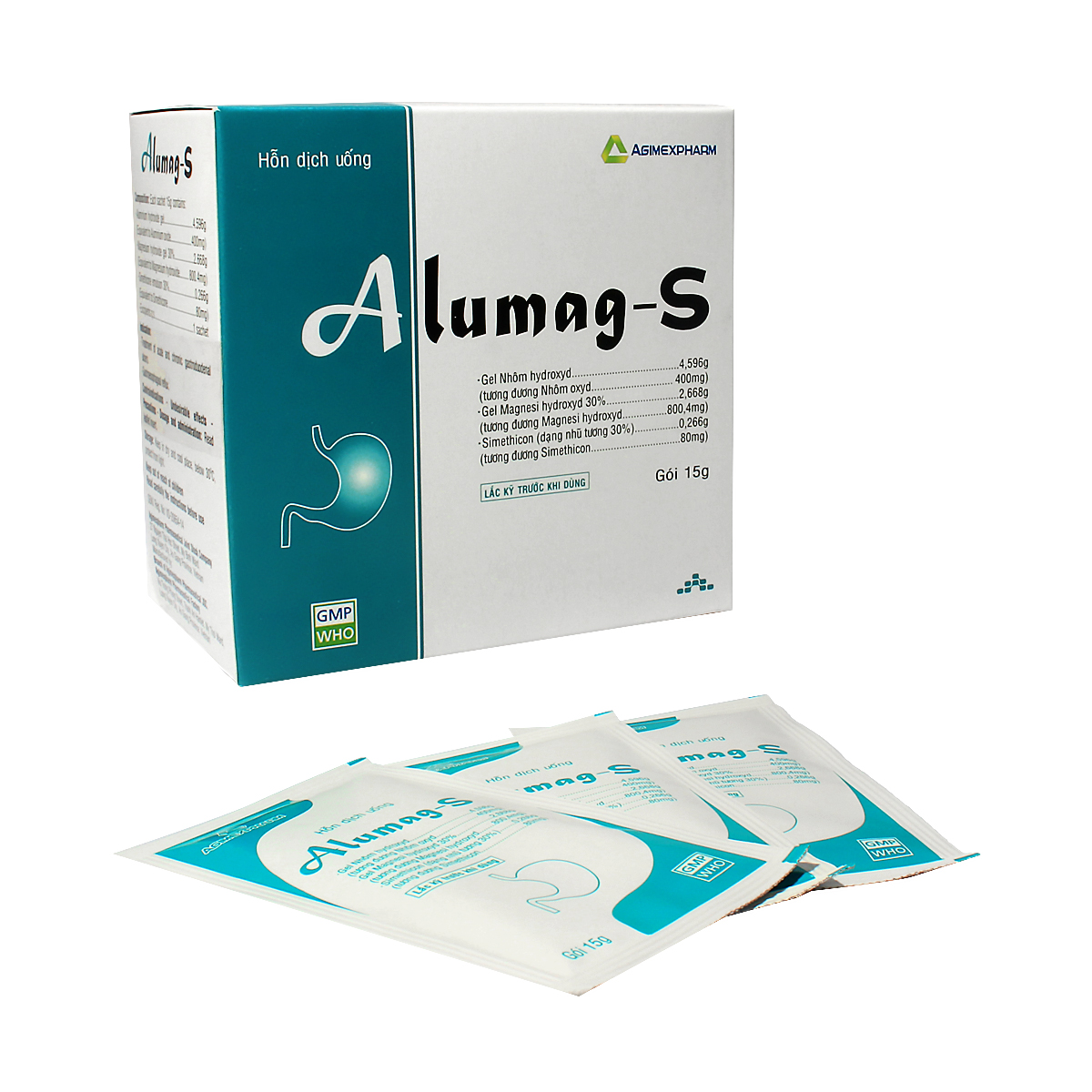
Indications:
Treatment of acute and chronic gastroduodenal ulcers.
Gastroesophageal reflux.
Administration and dosage:
Administration:
Alumag-S is taken between meals or within 30 minutes to 2 hours after meal, at bedtime or when there are symptoms.
Dosage:
Children: ½ to 1 sachet once, 2 to 4 times a day.
Adults: 1 sachet once, 2 to 4 times a day.
Contraindications:
Hypersensitivity to any active ingredient or other excipient in the medicine.
Alumag-S is not recommended for children under 3 months.
Warnings and precautions for use:
Renal impairment.
Patients who are taking other medicines: See details in interaction section.
Children under 1 year of age, Alumag-S is only used if it is really necessary.
The medicine contains sorbitol which may cause gastrointestinal discomfort and has a mild laxative effect.
The medicine contains methyl paraben and propyl paraben which may cause allergic reactions.
Pregnancy and lactation:
Pregnancy:
Alumag-S can be used for pregnant women but prolonged use of high doses should be avoided, the drug should only be used if the benefits outweigh the risks.
Lactation:
No documented undesirable effects have been reported, although the drug is excreted through breast milk, the amount is insufficient to cause undesirable effects in breastfed children.
Effects on ability to drive and use machines:
There is no evidence of the influence of Alumag-S on the ability to drive, use machinery.
Interactions, incompatibilities of medicine:
Interactions:
Combination of Alumag-S with following medicines: Quinidine, captopril, gabapentin, sucralfate, digoxin, iron containing products, tetracycline, isoniazid, phenothiazine, fat-soluble vitamins (especially vitamin D) etc. will lead to interfere with the absorption resulting to the reduction or loss of effectiveness of these medicines.
Incompatibilities:
Because there are no studies of drug incompatibility, do not mix this drug with other drugs.
Undesirable effects:
Side effects are classified according to frequency: Very common (ADR ≥ 1/10), common (1/100 ≤ ADR < 1/10), uncommon (1/1,000 ≤ ADR < 1/100), rare (1/10,000 ≤ ADR < 1/1,000), very rare (ADR < 1/10,000); cannot be estimated from the available data “Not known”.
Aluminum oxide: It may cause constipation. Using high doses of antacids containing aluminum for long time will prevent the absorption of phosphate leading to the risk of bone resorption and osteoporosis.
Magnesium hydroxide: It may cause diarrhea. Increased magnesium levels in the blood may occur in patients with impaired renal function. Patients with impaired kidney function may experience hypermagnesemia when using the drug.
Inform your physician about undesirable effects encountered when taking Alumag-S.
Overdose and management:
Overdose:
Diarrhea due to the effect of soluble magnesium salts on the intestinal tract.
Management:
In case of overdose, discontinue use and institute appropriate symptomatic treatment.
Pharmacodynamic properties:
Pharmacotherapeutic group: Antacids with antiflatulents.
ATC code: A02AF02
Aluminum oxide and magnesium hydroxide combined with simethicone produce layers to protect gastric mucous membrane. Simethicone with anti-foam action exerted by reducing the surface tension of the gas bubbles has effect on relief of flatulence and dyspepsia.
Aluminum oxide and magnesium hydroxide increase gastric pH and inhibit proteolytic effect of pepsin on the gastrointestinal mucosa – this effect is very important in patients with gastric ulcers. In addition, two active ingredients are often used together to reduce common side effects in the gastrointestinal tract (aluminum oxide causes constipation, magnesium hydroxide causes diarrhea).
Pharmacokinetic properties:
Aluminum oxide dissolves slowly in the stomach and reacts with gastric hydrochloric acid to form aluminum chloride and water. About 17 – 30% of the aluminum chloride formed is absorbed and is rapidly excreted by the kidneys in patients with normal renal function. Thus, aluminum accumulation can occur in patient with renal failure, often in bones and central nervous system, resulting in aluminum poisoning. In the small intestine, aluminum chloride is quickly transformed into insoluble alkaline aluminum salts which is poorly absorbed and excreted in the feces.
Aluminum oxide combines with dietary phosphate in the intestine forming insoluble nonabsorbable aluminum phosphate which is excreted in the feces. If phosphate intake is limited in patients with normal renal function, aluminum antacids decrease phosphate absorption and hypophosphatemia and hypophosphaturia may occur.
After oral administration magnesium hydroxide rapidly reacts with hydrochloric acid to form magnesium chloride and silicon dioxide water. It is normally excreted in the feces in the form of soluble and insoluble. A small amount of derivatives may be absorbed and excreted in the urine.
Storage conditions, shelf life, quality specification of the medicine:
Storage: Protect from humidity and light, below 300C.
Shelf life: 36 months from the manufacture date. Do not use this medicine after the expiration date.
Quality specification: In house.
A1204007705