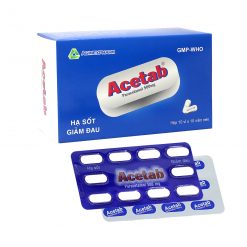
Indications:
Treatment of the symptoms of cold and flu: Headache, feverishness, sore throat, muscle pain.
Administration and dosage:
Administration:
ACETAB EXTRA is orally taken. It should not be used for self-medication of pain longer than 10 days by adults, 5 days by children or used for self-medication of high fever (over 39.50C), protracted fever for over 3 days, relapsing fever unless advised by a physician.
Dosage: This medicine use to adults and children 12 years and older.
The usual doses are as follows:
Adults: 1 to 2 tablets, 3 – 4 times daily (maximum: 8 tablets in 24 hours). The interval between doses should be at least 4 hours.
Children:
- Children from 12 to 16 years of age: 1 tablet/once.
- Children from 16 to 18 years of age: 1 – 2 tablets/once.
Dosage for children may be repeated every 4 – 6 hours as needed, but do not exceed 4 doses in 24 hours.
Contraindication: Hypersensitivity to paracetamol, caffeine or any excipients of the drug.
Warnings and precautions for use:
Doctors should inform patients about the signs of serious skin reactions such as Stevens- Johnson Syndrome (SJS), toxic epidermal necrolysis (TEN) or Lyell’s syndrome, and acute generalized exanthematous pustulosis (AGEP).
Paracetamol is relatively nontoxic at therapeutic dose. Sometimes, there are skin reactions including pruritus and urticaria; other hypersensitivity reactions including laryngeal edema, angioedema, and anaphylactoid reactions may rarely occur. Thrombocytopenia, leucopenia and pancytopenia have been associated with the use of p-aminophenol derivatives, especially with prolonged administration of large doses. Neutropenia and thrombocytopenic purpura have occurred with paracetamol. Rarely, agranulocytosis is reported in patients using paracetamol.
Paracetamol must be used with caution in:
- Patients with pre-existing anemia, since cyanosis may not be apparent, despite the dangerously elevated levels of methemoglobin in the blood.
- Patients with heart disease, lung disease, kidney failure or liver failure.
- Patients with glucose-6-phosphate dehydrogenase deficiency.
Avoid taking with other medicines containing paracetamol.
Excessive alcohol consumption can increase paracetamol hepatotoxicity; alcohol should be avoided or limited.
Caffeine in ACETAB EXTRA can cause central nervous system irritation, leading to insomnia if used in the evening.
Avoid using excessive caffeine (e.g: Tea, coffee …) while taking ACETAB EXTRA.
This product contains lactose. Patients with rare hereditary problems of galactose intolerance, the Lapp lactase deficiency or glucose-galactose malabsorption should not take this medicine
Pregnancy and lactation:
Pregnancy:
The safety of paracetamol during pregnancy has not been established with regard to possible undesirable effects on fetal development. At the end of pregnancy, when taken high doses, caffeine can cause cardiac arrhythmias in the fetus and newborn.
Co-administration of paracetamol with caffeine is not recommended during pregnancy because of the risk of preterm birth and low birth weight. Do not use this drug in pregnant women.
Lactation:
Caffeine passes into breast milk and may potentially have a stimulating effect on breastfed infants. Do not use this drug in breast-feeding women.
Effects on driving and operating machinery:
There has been no evidence of medicine effects on ability to drive and use machine.
Interactions, incompatibilities of medicine:
Interaction:
ACETAB EXTRA should not be used concurrently with any other paracetamol, caffeine-containing products.
Long-term use of high doses of paracetamol may mildly enhance the anticoagulant effect of coumarin and indandione derivatives.
The possibility of severe hypothermia should be considered in patients receiving concomitantly phenothiazine and antipyretic therapy.
Chronic and excessive consumption of alcohol may increase risk of paracetamol-induced hepatotoxicity.
Anticonvulsants (including phenytoin, barbiturate, carbamazepine), which induce hepatic microsomal enzyme may increase paracetamol-induced hepatotoxicity due to the increase of drug metabolism to produce liver toxic metabolites.
In addition, concurrent use of isoniazid with paracetamol may also lead to an increased risk of hepatotoxicity, but the exact mechanism of this interaction has not yet been determined.
The rate of paracetamol absorption may be increased by metoclopramide or domperidone.
Coadministration of paracetamol and cholestyramine decreases the absorption of paracetamol, therefore cholestyramine should not be used within 1 hour after taking paracetamol to have optimal analgesic effect.
Incompatibilities: Because there are no studies of drug incompatibility, do not mix this drug with other drugs.
Undesirable effects:
ACETAB EXTRA is less likely to have side effects when taken at recommended doses and duration of use, but some of the following side effects may occur:
| Body system | Undesirable effects |
| Paracetamol | |
| Blood and lymphatic system disorders | Thrombocytopenia. Agranulocytosis |
| Immune system disorders | Anaphylaxis
Skin hypersensitivity reactions including skin rash, angioedema and Stevens Johnson syndrome/toxic epidermal necrolysis |
| Respiratory, thoracic and mediastinal disorders | Bronchospasm* |
| Bile disorders | Hepatic disorders |
* There have been cases of bronchospasm with paracetamol, but these are more likely in mild asthmatics sensitive to aspirin or other NSAIDs.
| Caffeine | |
| Central nervous system | Insomnia, fatigue, dizziness, nervousness, digestive disorders. Long-term use causes drug tolerance, when abruptly stopping the drug can cause irritation, restlessness, lethargy, headache… |
| When the recommended paracetamol-caffeine dosing regimen is combined with dietary caffeine intake, the resulting higher dose of caffeine may increase the potential for caffeine-related adverse effects such as insomnia, restlessness, anxiety, irritability, headaches, gastrointestinal disturbances and palpitations. | |
Overdose and management:
Overdose:
If any of the overdose symptoms occur as shown below, the patient should discontinue ACETAB EXTRA and inform the physician or go to medical facility immediately.
Paracetamol: Nausea, vomiting, and abdominal pain usually occur within 2 to 3 hours after ingestion of toxic dose. Methemoglobinemia causes cyanosis of the skin, mucous membranes, and nails. Dose dependent hepatic necrosis is the most severe acute toxicity due to overdosage and can be fatal.
Caffeine: Symptoms of epigastric pain, vomiting, increased excretion, tachycardia, cardiac arrhythmia, central nervous system irritation (insomnia, restlessness, tremors, seizures etc.)
Management:
Management of paracetamol overdose: Early diagnosis is very important for the treatment of paracetamol overdose. In severe poisoning cases actively supportive treatment is important. Gastric lavage is applied in all cases, preferably within 4 hours after ingestion.
Antidote is required: N-acetylcysteine, methionine.
In addition, activated charcoal can be used to reduce the absorption of the drug.
Management of caffeine overdose: There are no specific antidote but supportive treatment can be applied.
Pharmacodynamic properties
Pharmacotherapeutic group: Analgesics, antipyretics
ATC code: N02B E51
- Paracetamol:
Paracetamol (also known as acetaminophen or N-acetyl-p-aminophenol) is an active metabolite of phenacetin, an effective analgesic-antipyretic agent. Paracetamol is used for the temporary relief of mild to moderate pain. It is most effective for low-intensity pain without visceral origin.
Paracetamol reduces body temperature in people with fever, but rarely lowers normal body temperature. It acts on the hypothalamus to produce antipyresis, heat dissipation increases due to vasodilation and increased peripheral blood flow.
At therapeutic doses, the drug has little effect on the cardiovascular and respiratory system, no gastric irritation, no effect on platelet aggregation or bleeding time.
When paracetamol is overdosed, a reactive metabolite called N-Acetyl-p-benzoquinone imine is produced which causes severe hepatotoxicity.
- Caffeine:
Caffeine is a derivative of xanthine (methylxanthine) with CNS stimulant effect, which helps to stay alert, increases mental activity, supports pain relief, and helps the muscles working easily. At dose of 65 mg/tablet, caffeine is used as a mild central nervous stimulant to enhance the analgesic effect of paracetamol.
Pharmacokinetic properties
- Paracetamol:
Absorption: Paracetamol is readily and almost completely absorbed from the gastrointestinal tract. Peak plasma levels occur within 30 to 60 minutes after oral administration.
Distribution: Paracetamol is distributed quickly and evenly in most tissues of the body. About 25% of paracetamol in the blood is bound to plasma proteins.
Metabolism: Paracetamol is N – hydroxylated by cytochrome P450 enzyme to form N – acetyl – benzoquinone imine, an intermediate agent with high reactivity. This substance reacts with sulfhydryl groups in glutathione and deactivated. However, if taking high doses of paracetamol, this metabolite is formed in sufficient quantities to deplete the glutathione of the liver; in that situation, N-acetyl-benzoquinone imine which is not inactivated by conjugation with glutathione may cause hepatotoxicity, leading to inflammation and hepatocellular necrosis.
Elimination: The plasma half-life of paracetamol is 1.25 – 3 hours. It is mostly excreted in the urine (90% – 100% of the therapeutic dose on the first day), mainly in conjugated form with glucuronic acid.
- Caffeine:
Caffeine is absorbed quickly and completely after oral administration. Maximum plasma concentration is achieved within 1 hour. Caffeine is widely distributed throughout the body and passes readily into the central nervous system and into saliva. Caffeine is also present in breast milk at low concentrations and also crosses the placental barrier.
The caffeine half-life is about 3 – 7 hours. Caffeine is almost entirely metabolized in the liver by oxidation, demethylation and acetylation, subsequently excreted in the urine as metabolites, only about 1% of the dose was found to be constant in the urine
Storage conditions, shelf life, quality specification of the medicine:
Storage conditions: Protect from humidity and light, below 300C.
Shelf life: 36 months from the manufacture date.
Quality specification: In house.