




Indications
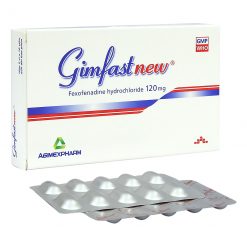
Treatment of symptoms associated with seasonal allergic rhinitis such as sneezing; runny nose; itchy nose, palate, and throat; itchy red and watery eyes; chronic idiopathic urticaria.
Dosage and administration:
- Adults and children aged 12 years and over: 1 tablet twice daily.
- Patients with kidney failure: The recommended initial dose is a single dose of 60 mg once daily.
- Dose reduction of fexofenadine in elderly patients and impaired hepatic patients is not necessary.
Contraindications:
– Hypersensitivity to any ingredients of Agimfast®60.
– Children under 12 years of age.
Precautions:
- Use with caution in the elderly, hepatic or renal impaired patients.
- Caution should be exercised in people who are driving and operating machinery.
- Fexofenadine should be administered with caution in patients with a risk of cardiovascular disease or with a prolonged QT interval.
- Fexofenadine should not be used concurrently with other antihistamine agent.
Interactions:
- Coadministration of fexofenadine with ketoconazole and erythromycin increases area under the plasma drug concentration-time curve, the mechanism may be due to increased absorption and decreased excretion of fexofenadine. However, this interaction is not considered clinical meaningful.
- Antacids containing alumimium or magnesium reduce bioavailability of fexofenadine. It is advisable to leave 2 hours between administration of fexofenadine and these antacids.
Pregnancy and lactation:
- Pregnancy: There are no adequate data on fexofenadine use during pregnancy. Fexofenadine should be used during pregnancy only if the potential benefit outweighs the potential risk to the fetus.
- Lactation: It is not known if Agimfast®60 is excreted in human milk; therefore, fexofenadine should be used cautiously in nursing mothers.
Effects on ability to drive and use machines:
Although fexofenadine rarely causes drowsiness, caution should be exercised when driving or operating machinery.
Undesirable effects:
– The undesirable effects of Agimfast®60 are not affected by the dose, age, sex and race of patients.
– Common: Drowsiness, fatigue, headache, insomnia, dizziness; nausea, indigestion; viral infections (colds, influenza), dysmenorrhea, upper respiratory infections, itchy throat, cough, fever, otitis media, sinusitis, back pain.
– Inform your physician about side effects encountered while taking this drug.
Pharmacodynamics:
Fexofenadine is a second-generation antihistamine with specific, selective peripheral H1–receptor antagonist activity. Fexofenadine which is an active metabolite of terfenadine has no cardiotoxicity because it does not block potassium channel involved in repolarization of cardiac cells.
- Fexofenadine has no significant acetylcholine and dopamine antagonist activity and exhibits no alpha1-adrenergic or beta-adrenergic-receptor blocking effects. At therapeutic doses, no sedative or other central nervous system effects are observed. Agimfast®60 has fast and prolonged effects because it slowly binds to H1 receptor to form a sustainable complex which is separated slowly.
Pharmacokinetics:
- Oral Agimfast®60 is well absorbed. After taking one 60 mg tablet, peak blood concentration is about 142 nanogram/ml, achieved after 2-3 hours. Food reduces the peak plasma concentration by 17%, but does not delay the time to reach peak concentration of the drug.
- Fexofenadine is 60-70% plasma protein bound, predominantly to albumin and α1-acid glycoprotein. The volume of distribution is 5.4 to 5.8 liters/kg. It is unknownwhether it crosses the placenta or is distributed in breast milk, but, when terfenadine is used, fexofenadine is discovered as a terfenadine metabolite in breast milk. Fexofenadine does not cross the blood brain barrier.
- Approximately 5% of the dose is metabolized. Nearly 0.5 – 1.5% is metabolized in the liver by cytochrome P450 enzymes into inactive substances. 3.5% is converted into methyl ester derivatives, mainly due to the intestinal flora.
– Elimination half-life of fexofenadine is approximately 14.4 hours, prolonged in patients with renal impairment. The drug is mainly excreted in the feces (approximately 80%); 11-12% of the dose is excreted in urine as unchanged form.
Overdose and management:
– Information on acute toxicity of fexofenadine is limited. However, drowsiness, dizziness, dry mouth has been reported.
– Management: Standard measures should be considered to remove the unabsorbed medicines remaining in the gastrointestinal tract. Symptomatic and supportive treatment is recommended.
– Haemodialysis reduces plasma concentrations slightly (1.7%). There is no specific antidote.
KEEP OUT OF REACH OF CHILDREN
READ CAREFULLY THE INSTRUCTIONS BEFORE USE
FOR FURTHER INFORMATION, CONSULT YOUR PHYSICIAN
Storage: Protect from humidity and light, below 300C.
Shelf life: 36 months from the manufacture date.
Do not use the drug after the expiry date printed on the label.
A1202027601















 ENGLISH