Indications:
Treatment of hypertension: It may be used alone or in combination with other classes of antihypertensives.
Agimstan is used to replace ACE inhibitors for the treatment of heart failure or diabetic nephropathy.
Administration, dosage:
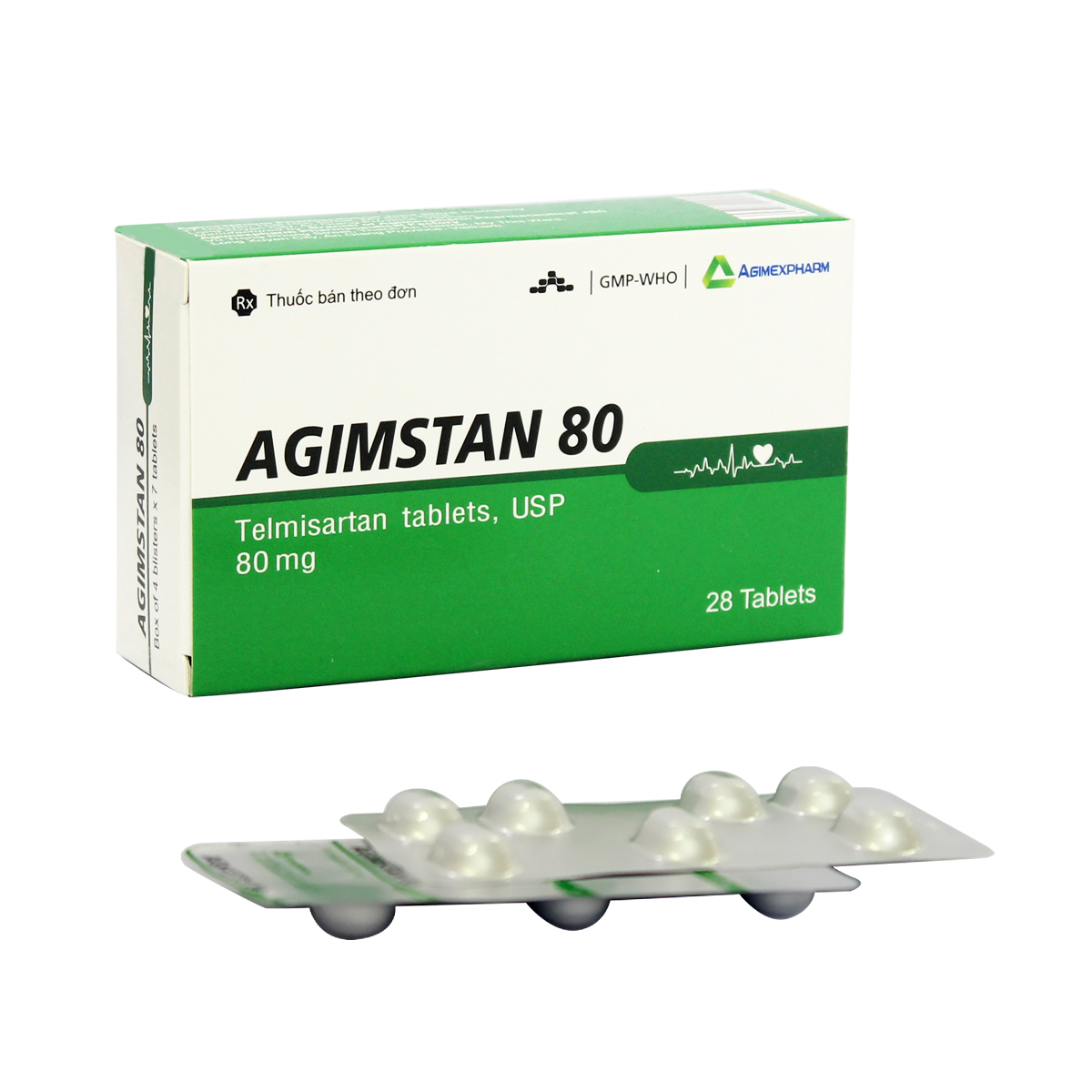
Administration: Agimstan 80 tablets are for once-daily oral administration and regardless of meals because food slightly reduces the bioavailability of telmisartan.
Dosage:
Treatment of hypertension: When initiating telmisartan therapy, dosage is usually adjusted after 1 month (or less than in high-risk patients such as those with hypertension stage 2). When blood pressure is not adequately controlled by the initial dose, it takes several months to control blood pressure as well as avoid undesirable effects of the drug.
Monotherapy: Adults: 40 mg orally once a day. If needed, the dose of telmisartan can be increased to a maximum of 80 mg once daily after every 4 weeks.
Combination therapy: In patients not responding to telmisartan monotherapy, telmisartan may be used in combination with thiazide diuretics such as hydrochlorothiazide. It is recommended to use the fixed dose combinations of telmisartan and hydrochlorothiazide.
Renal impairment: No dose adjustment is required for patients with mild to moderate renal impairment. This product should not be administered to patients with severe renal impairment (as the starting dose in these patients is 20 mg). Telmisartan/Hydrochlorothiazide fixed dose combination is contraindicated in patients with glomerular filtration rate < 30 ml/min.
Hepatic impairment: In patients with mild to moderate hepatic impairment or biliary obstruction, the dose should not exceed 40 mg once daily as monotherapy. Telmisartan/Hydrochlorothiazide fixed dose combination is contraindicated in patients with severe hepatic impairment.
Elderly: No dose adjustment is necessary for elderly patients
Children and adolescents aged below 18 years: The safety and efficacy of Agimstan 80 in these patients have not been established.
Some special attention on the handling of the medicine before and after use:
There are no special requirements for handling the drug after use.
Contraindications:
Hypersensitivity to any component of this product.
Pregnant women and breastfeeding mothers.
Severe renal impairment. Renal impairment with serum creatinine ³ 250 micromoles/liter or serum potassium ≥ 5 mmol/l or Clcr ≤ 30 ml/min.
Severe hepatic impairment or biliary obstruction.
Warnings and precautions for use:
Potassium levels in the blood should be monitored, especially in the elderly and patients with renal insufficiency. A lower starting dose is recommended in these patients.
Aortic and mitral valve stenosis.
Hypertrophic obstructive cardiomyopathy.
Severe congestive heart failure (particularly sensitive to changes in the renin-angiotensin-aldosterone system, accompanied by oliguria, hyperuremia, acute renal failure (possibly fatal)).
Dehydration (volume and sodium depletion due to vomiting, diarrhea, vigorous diuretic therapy, dialysis, dietary salt restriction) increases the risk of excessive reduction of blood pressure. This disorder should be corrected before telmisartan therapy or dose reduction and monitored closely when starting the treatment. Increase in telmisartan dose is not contraindicated when there is transient hypotension, however, the therapy should be monitored closely after blood pressure has been stabilized (as increase in fluid volume)
Progressive gastric and duodenal ulcers or other gastrointestinal disease (increased risk of gastrointestinal bleeding).
Mild and moderate hepatic impairment. Agimstan 80 should be used with caution in patients with biliary obstructive disorders as the predominant route of elimination of telmisartan is through biliary excretion and hepatic clearance for telmisartan may be reduced.
Renal artery stenosis.
Mild and moderate impaired renal function.
Potassium levels in the blood should be monitored, especially in the elderly and patients with renal insufficiency. A lower starting dose is recommended in these patients.
Caution should be taken in patients with a history of angioedema with or without regard to administration of angiotensin converting enzyme inhibitors or angiotensin II receptor blockers.
Telmisartan may cause porphyria and should only be used in the absence of other safer alternatives and caution should be taken in severe patients.
Pregnancy and lactation:
Pregnancy:
The use of telmisartan is not recommended during the first trimester of pregnancy. Patients planning pregnancy should be changed to alternative treatments. Telmisartan is contraindicated during the second and third trimesters of pregnancy because the drug directly acts on the renin-angiotensin system, which is known to induce human fetotoxicity: Hypotension, reversible or irreversible renal failure, anuria, skull ossification retardation and death. Oligohydramnios (possibly due to reduced fetal renal function) associated with limb spasticity, craniofacial deformity and fetal lung hypoplasia have been reported. When pregnancy is detected, discontinue telmisartan as soon as possible.
Lactation:
Telmisartan is contraindicated during lactation as it is not known whether telmisartan is excreted in human milk. Because of the potential for adverse effects on the nursing infant, a decision should be made whether to discontinue nursing or discontinue the drug, taking into account the importance of the drug to the mother.
Effects on ability to drive, use machines:
It should be taken into account that dizziness or drowsiness due to hypotension may occasionally occur when taking antihypertensive therapy. Therefore, caution should be taken when driving, using machine or engaging in activities that require complete alertness.
Interactions, incompatibilities of medicine:
Interaction of the drug with other drugs and other types of interactions:
Data on the safety and efficacy of the combination of telmisartan and ACE inhibitors or beta-adrenergic blocking agents, have not been established. Telmisartan may increase the blood pressure lowering effect of these drugs. Do not co-administer aliskiren with telmisartan in patients with diabetes (ClCr < 60 ml/min).
Co-administration of telmisartan with NSAIDs, including selective COX-2 inhibitors may result in deterioration of renal function, including possible acute renal failure. If needed, renal function in these patients should be monitored.
A pharmacokinetic interaction of telmisartan with drugs which inhibit or induce cytochrome P450 (CYP) isoenzymes rarely occurs. Telmisartan is not metabolized by the cytochrome P450 (CYP) isoenzymes. Telmisartan did not inhibit CYP isoenzymes except for CYP2C19.
Digoxin: Co-administration of telmisartan with digoxin increased digoxin peak plasma concentration. When initiating, adjusting, and discontinuing telmisartan, monitor digoxin levels in order to maintain levels within the therapeutic range.
Warfarin: Co-administration of telmisartan with warfarin for 10 days slightly decreased the mean warfarin trough plasma concentration; this decrease did not result in a change in the International Normalized Ratio (INR).
Diuretics: Increases the antihypertensive effect of telmisartan.
Potassium sparing diuretics: potassium supplements or potassium-containing salt substitutes may lead to a significant increase in serum potassium.
Acetaminophen, amlodipine, glyburide, ibuprofen and simvastatin: There is almost no pharmacokinetic interaction.
Incompatibilities:
Because there are no studies of drug incompatibility, do not mix this drug with other drugs.
Undesirable effects:
Undesirable effects are classified according to frequency: Very common (ADR ≥ 1/10), common (1/100 ≤ ADR < 1/10), uncommon (1/1,000 ≤ ADR < 1/100), rare (1/10,000 ≤ ADR < 1/1,000), very rare (ADR < 1/10,000); not known (cannot be estimated from the available data).
Uncommon:
Body as a whole: Fatigue, headache, hypotension, vertigo especially in volume-depleted patients (e.g. patients taking high doses of diuretics), swelling in the hands, lower legs, and feet, angioedema, increased sweating, blurred vision.
CNS: Agitation, anxiety, dizziness.
Gastrointestinal: Dry mouth, nausea, abdominal pain, gastroesophageal reflux, dyspepsia, flatulence, anorexia, diarrhea.
Urinary: Kidney failure, increases in creatinine and blood urea nitrogen, urinary tract infections.
Respiratory: Sore throat, sinusitis, upper respiratory tract infection, influenza-like symptoms (cough, congestion or earache, fever, nasal congestion, runny nose, sneezing, sore throat).
Musculoskeletal: Back pain, muscle spasms, myalgia, and tendinitis like symptoms.
Metabolic: Hyperkalemia.
Rare:
Body as a whole: Angioedema.
Eye: Visual disturbance.
Cardiovascular: Tachycardia, hypotension or syncope (in volume-or salt-depleted patients, patients being treated with diuretics, especially upon standing posture).
Gastrointestinal: Gastrointestinal bleeding.
Skin: Skin rash, urticaria, itching.
Liver: Increased hepatic enzyme.
Hematologic: Decreased hemoglobin, neutropenia.
Metabolic: Elevated blood uric acid level, hypercholesterolemia.
Overdose and management:
There is limited information available with regard to overdose in humans.
Overdose: Bradycardia (due to parasympathetic (vagal) stimulation) or tachycardia, vertigo, dizziness, hypotension.
Management: The treatment should be symptomatic and supportive.
Pharmacodynamics:
Pharmacological group: Cardiovascular system – Agents acting on the renin-angiotensin system – Angiotensin II receptor blockers, plain.
ATC code: C09CA07
Telmisartan is a benzimidazole derivative and a non-peptide angiotensin II receptor antagonist with antihypertensive property. Telmisartan selectively antagonizes angiotensin II binding to the angiotensin II AT1 subtype receptor, located in vascular smooth muscle and adrenal gland.
In the renin-angiotensin system, angiotensin II is formed from angiotensin I in a reaction catalyzed by angiotensin-converting enzyme (ACE). Angiotensin II is a potent vasoconstrictor, it stimulates the synthesis and release of aldosterone from the adrenal cortex and has effect on cardiac stimulation. Aldosterone increases sodium reabsorption and potassium excretion by the kidneys.
Telmisartan interferes with the binding of angiotensin II to the angiotensin II AT1-receptor by binding to the AT1-receptors in vascular smooth muscle and the adrenal gland resulting in vasodilation and reduction in aldosterone effects.
AT2 receptor has been found in many tissues, but AT2 is not known to be associated with cardiovascular homeostasis. Telmisartan has much greater affinity (> 3,000 fold) for the AT1 receptor than for the AT2 receptor. Unlike ACE inhibitors, which are widely used in the treatment of hypertension, angiotensin II receptor antagonist does not inhibit the degradation of bradykinin, thus does not cause persistent dry cough – an undesirable effect which is usually seen with ACE inhibitors. Telmisartan is used for people who stop using ACE inhibitor because of experiencing cough.
In human, an 80 mg dose of telmisartan almost completely inhibits the angiotensin II evoked blood pressure increase. Larger doses (up to 160 mg) did not appear to cause a further decrease in blood pressure of telmisartan. The inhibitory effect is maintained over 24 hours and still measurable up to 48 hours. After the first dose of telmisartan, the antihypertensive activity gradually becomes evident within 3 hours. The maximum reduction in blood pressure is generally attained 4 to 8 weeks after the start of treatment and is sustained during long-term therapy. In patients with hypertension telmisartan reduces both systolic and diastolic blood pressure without affecting pulse rate. The antihypertensive efficacy of telmisartan is comparable to that of agent representative of other classes of antihypertensive medicinal products.
Similar to angiotensin receptor antagonists, telmisartan shows an effect in reducing the rate of progression to renal disease or microalbuminuria in patients with diabetes and the use of telmisartan is recommended in this population.
Telmisartan is also used in treating congestive heart failure. However, similar to angiotensin II receptor antagonists, telmisartan should only be used in patients who have been prescribed ACE inhibitors but can not tolerate the drug (e.g., in patients with cough or angioedema).
Pharmacokinetics:
Absorption: Telmisartan is rapidly absorbed from the gastrointestinal tract. The absolute oral bioavailability of telmisartan is dose dependent: At 40 and 160 mg dose the bioavailability was 42% and 58%, respectively. Food slightly reduces the bioavailability of telmisartan (with a reduction of about 6% after a 40 mg dose). Following oral administration, peak plasma concentrations of telmisartan are reached in 0.5 to 1 hour after dosing.
Distribution: Telmisartan is highly bound to plasma proteins (> 99%), mainly albumin and α1 -acid glycoprotein. Plasma protein binding is constant over the concentration range achieved with recommended doses. The volume of distribution for telmisartan is approximately 500 liters.
Metabolism: Following oral administration, telmisartan is metabolized to form a pharmacologically inactive acyl glucuronide.
Elimination: Most of the administered dose (> 97%) was eliminated unchanged in feces via biliary excretion; only minute amounts (< 1%) were found in the urine. The elimination half-life of telmisartan is about 24 hours, trough plasma concentrations of telmisartan with once daily dosing are about 15% to 20% of peak plasma concentrations.
Telmisartan pharmacokinetics has not been investigated in patients < 18 years of age. The pharmacokinetics of telmisartan does not differ between the elderly and those younger than 65 years.
Storage conditions, shelf life, quality specification of the medicine:
Storage conditions: Protect from humidity and light, below 300C.
Shelf life: 36 months from the manufacture date.
Quality specification: USP.
A1201032903